Finding Common Ground - by Janet Browne
What our cultural exchange trip to Serbia taught us about community, creativity and connection.
In March, the Raw Material team travelled from Brixton to Subotica for a three-day cultural exchange with Klara i Rosa. The trip was funded by the British Council through the Culture Connects scheme.
We didn't entirely know what to expect, and that's worth saying.
Subotica sits close to the Hungarian border in the north of Serbia. Our hosts were upfront about it: it's not a city with much of a tourist offer. Sundays, most things close. But it has a community, a culture, and architecture that genuinely stops you mid-sentence. Art Nouveau buildings, a music school, squares that feel lived-in.
We walked the city on Friday morning before anything else started. It felt like the right way to arrive somewhere, taking it in before trying to leave any impression of our own.
Since 2019, Klara i Rosa has been harnessing the power of arts and culture to strengthen community life in Subotica. Through work with young people, women, activists and diverse ethnic communities, they have created opportunities for connection, participation and belonging in a complex social and political landscape.
Spending time with the team made it clear that this work is not always straightforward. In a city shaped by multiple cultures and identities, creating spaces where people can come together through creativity feels both valuable and quietly courageous.
Before the trip, I think many of us understood cultural exchange in principle. You share ideas, experiences and perspectives, then hopefully everyone leaves having learned something new. What became clearer in Subotica was that the best exchanges are not really about teaching at all. They are about curiosity. About discovering what happens when people from different places, histories and traditions spend enough time together to move beyond assumptions and stereotypes. Whether through music, food, conversation, language or creative practice, the exchange becomes less about difference and more about understanding.
By the end of the trip, I found myself thinking less about the definition of cultural exchange and more about the moments where it actually happened.
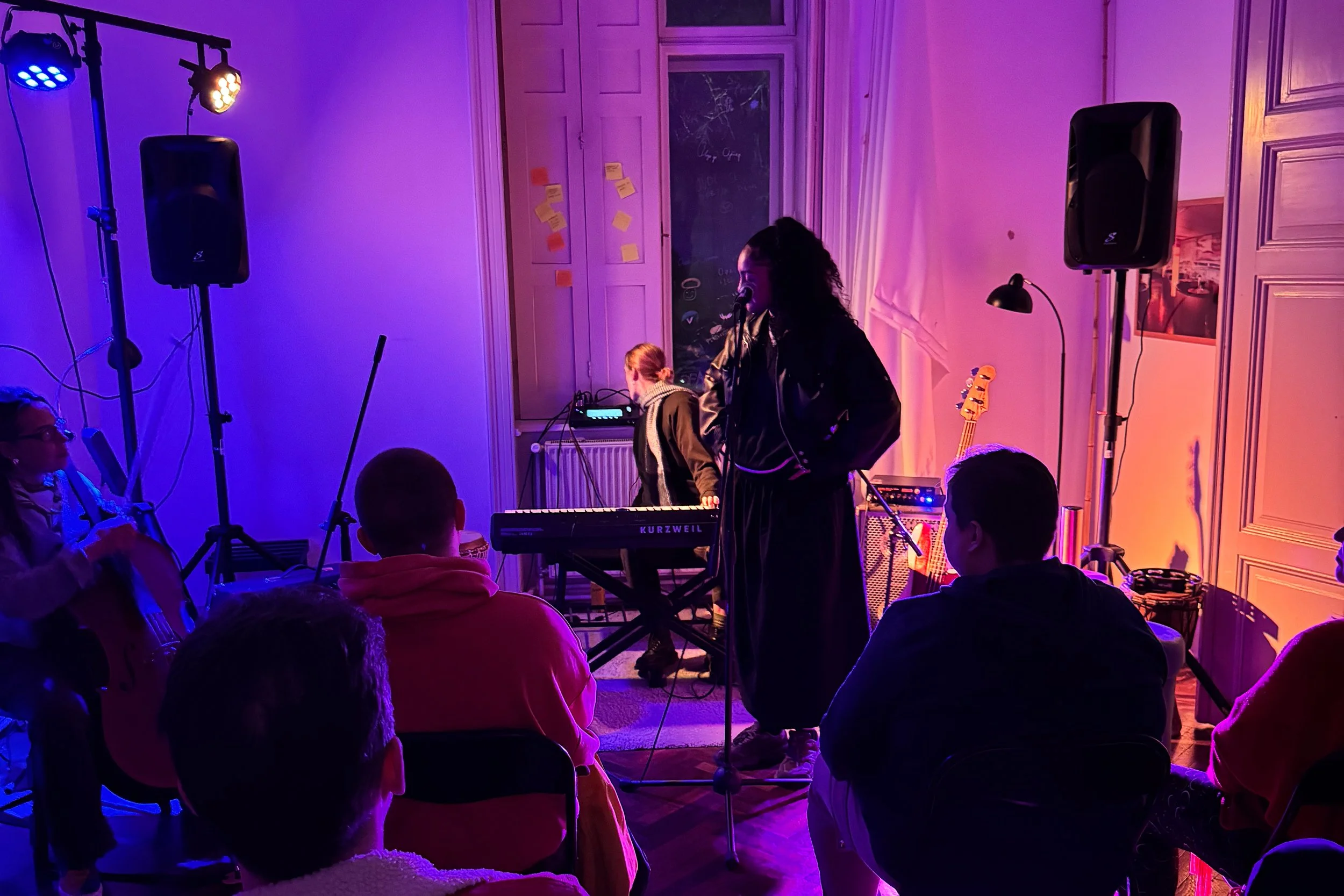
The programme ran across three days. It was more structured at one end, with the Raw Material team leading a series of workshops on everything from funding to monitoring and evaluation, followed by a public evening that opened with a panel discussion on creativity and mental health. We then moved into a Mindful Music session, open to everyone, no experience needed.
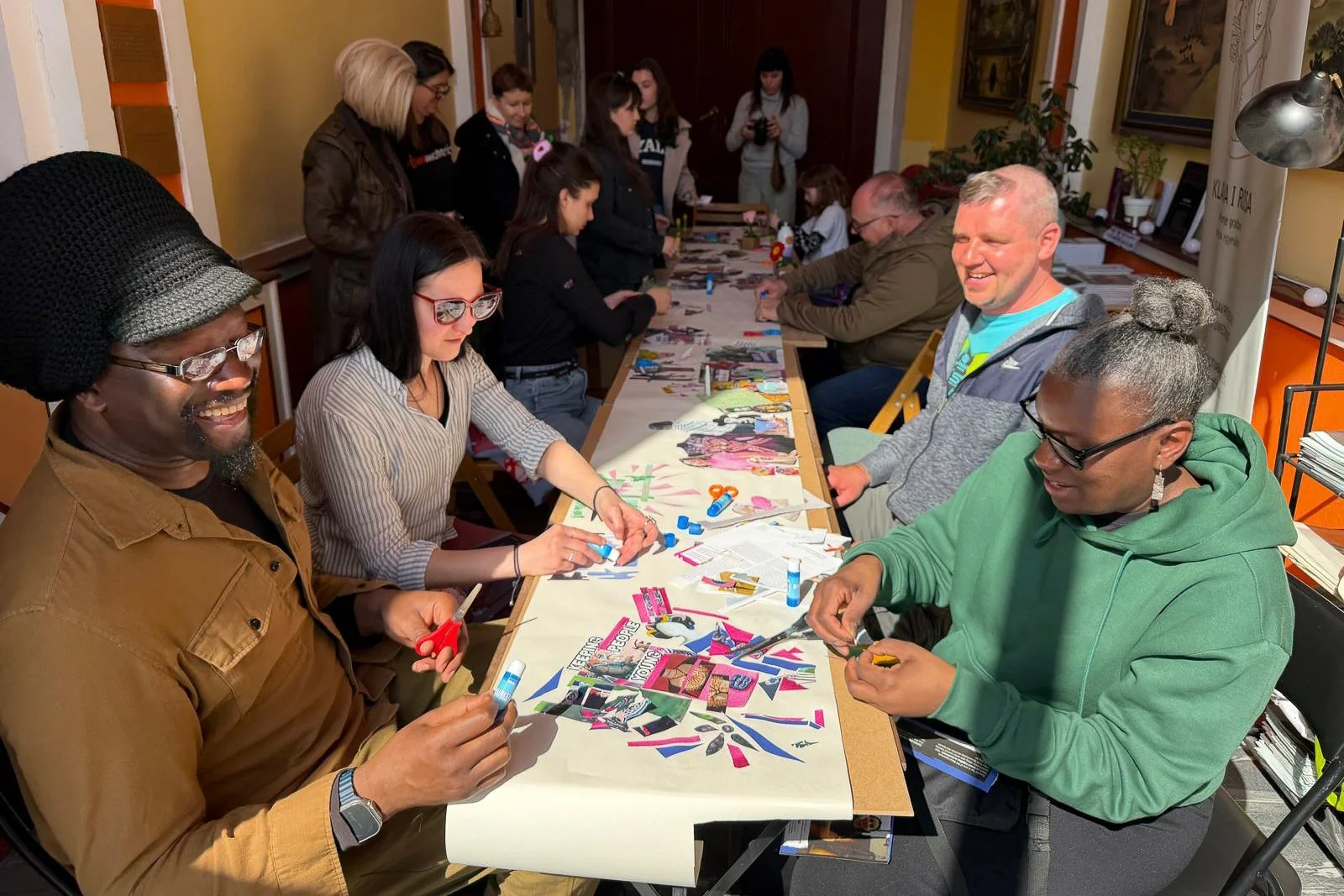
Saturday mixed taster workshops in the morning, craft and collage and a beginner music production session, with an afternoon at Palić lake, and an Open Mic and Jam in the evening.
Sunday was quieter: a Vocal Playground workshop in the morning, then lunch at Kelebija at the home of Heni, a performer and actress who lives with her husband in a house they built themselves from mud and straw in a forest outside the city.
As the weekend unfolded, it became harder to separate what was uniquely Serbian from what felt universally human. Our organisations may be separated by over 1000 miles, but we are often trying to answer remarkably similar questions.
How do we create spaces where people feel welcome? How do we foster connection, confidence and belonging? How do we demonstrate the value of creative participation?
Like Raw Material, Klara i Rosa have been running engaging participatory arts programmes for their community for many years. They create much-needed spaces for expression, connection and belonging.
What they hadn't yet done, is describe it through the lens of Creative Health; the idea that creative practice can play a meaningful role in mental health and wellbeing, and that its impact can be evidenced, advocated for and embedded within how organisations understand and communicate their work.
We were not arriving with a completely new approach but simply offering language and frameworks for practices they had developed organically over the years. This became particularly clear in conversations about monitoring and evaluation.
How do you capture changes in confidence, belonging or social connectedness? How do you evidence the impact of creative participation in ways that funders and communities can recognise? These are questions Raw Material has spent years exploring and refining in practice, developing tools and approaches that help demonstrate the value of creative participation beyond artistic outputs alone. The discussions felt less like teaching and more like a genuine exchange of experience, ideas and learning.
Cultural exchange is often described as the sharing of ideas, traditions and experiences between people from different backgrounds. That definition is accurate enough, but it doesn't really tell you what it feels like in practice. It also says little about the assumptions that get challenged along the way.
Through conversations with the Klara i Rosa team, we learned more about the realities of operating a multicultural arts organisation within an increasingly nationalistic political climate.
Subotica is a genuinely multicultural city, Serbian, Croatian and Hungarian communities among others, and Klara i Rosa serves that full range. Doing so within Serbia's current socio-political climate is not straightforward. It requires a real commitment to the principle that arts and culture belong to everyone, and a willingness to hold that line when the broader environment isn't supportive of it.
It was a reminder that community arts work does not happen in a vacuum. Every organisation, including our own, is shaped by the social and political environment around it.
Our contexts may be different, but we share an understanding of what it means to insist that creative participation is essential rather than optional, and to keep building the evidence base that makes that case.
Sometimes the clearest examples of cultural exchange happen away from the formal programme. Sometimes it looks less like a panel discussion or workshop, and more like a group of enthusiastic Londoners teaching a room of Serbian locals the Electric Slide to Cameo's Candy.
Nobody had planned it. Nobody had written it into the programme.
If you know, you know: the moment those opening chords play, something collective kicks in. It's the kind of song that stops you mid-conversation and pulls you onto the dance floor, whether you planned to be there or not. Before long, people who had never heard the song before were joining in, laughing through missed steps and helping each other find the rhythm.
It was unscripted, it was joyful, and it probably said more about what the three days had actually been than anything on the agenda.
Looking back, I don't think cultural exchange is simply what happens when knowledge is shared from one place to another.
It happens when people are willing to step fully into each other's worlds, however briefly.