Black is The Color Of My Voice - Raw Material Review
A review by Ellen Araya
Apphia Campbell’s Black is the Color of My Voice takes the audience on an emotional journey through the life of Nina Simone in the aftermath of her father’s death. Through reflective storytelling, Campbell recalls Simone’s evolution from a gifted piano prodigy to a distinguished jazz performer whose voice becomes a beacon of hope during the Civil Rights Movement. The audience is given a glimpse into the turmoil, grief and resilience Simone experienced in her life through musical interludes and an intense performance.

Photography : Rod Penn
The first thing I always notice when watching a play is the set. The minimalist set composed of a bed, desk, suitcase and chair, is clearly very simple, yet every element is used with deliberate intention. The stripped back staging allows all focus to remain on Campbell’s performance. Her blocking on stage is particularly effective when she mimics her mother by elevating herself by standing on the bed. This physical elevation introduces moments of comedy but simultaneously establishes the authority her mother held in the household as this is the only instance in which Simone is raised above the stage’s natural level.
The use of the framed photograph of her late father is the production’s most symbolic device. Campbell’s proximity to the frame shifts in accordance with her emotional state, to begin with she remains close during humorous recollections of her life and instances herself when recalling traumatic experiences, in particular, the domestic violence she endured in her marriage. This physical withdrawal suggests there is a deep rooted shame in Simone and an unwillingness to let her father be a witness to her suffering. When she contrasts this behaviour by having a vulnerable moment with her father as Campbell cradles the frames and sways gently, allowing her guard to come down. This gesture deepens the intimacy between not only her and her father but between Campbell and the audience. However, the pathos of the scene is diminished slightly due to her placement behind the desk, this created a physical barrier between the performer and the audience. Had this occurred closer to centre stage, the emotional impact would have been greater and heavier.

Photography: Rod Penn
The childhood performance scene is a striking example of Nina's experiences when venue staff attempted to remove her parents from the audience, a young Nina publicly scruntinized the injustice from the stage. Although her parents instinct was to leave quitely, Nina refused to stay silent, this formative moment foreshadows the activist she would become. The line “ I had to fight, even if it was going to kill me” resonates powerfully, emphasising Simone’s unwavering commitment to the Civil Rights Movement. Her reaction to the assassination of Martin Luther King Jr. is delivered with raw devastation. The scene compels the audience to confront the reality that black empowerment was frequently posed as a threat and was violently suppressed, echoing her parent’s fear for their outspoken daughter.
Music is used beautifully throughout the production as Campbell performs with remarkable vocal control and emotional depth. The closing performance of “Feeling Good” felt fitting - not due to its popularity, but as a reclaimed strength after recounting profound hardships in her life. However, with the inclusion of a live band, her performance could have been amplified and in doing so, would have enriched the club performance scenes, adding a level of authenticity and immersing the audience fully in the atmosphere of Simone’s live performances.
The lighting design effectively supports the narrative’s emotional shifts throughout. A warm amber wash dominates much of the production, perhaps reflecting the tenderness of Simone and her father’s relationship. The most conspicuous lighting choice occurs during the announcement of Martin Luther King Jr’s death, when a stark white spotlight isolates Campbell from the rest of the stage, creating the illusion of a television screen illuminating her. The sudden shift in tone, paired with the recorded broadcast, intensifies the scene’s realism and transports the audience to 1968 when the news was first broken. The deliberate contrast between this scene and warmer hues shown throughout allows this scene to have more of a climatic effect. Whilst colours such as purple lighting were used to enhance the authenticity of nightclub scenes, further variation in colour may have intensified the imagination of the environment and crowd’s energy during performance scenes.
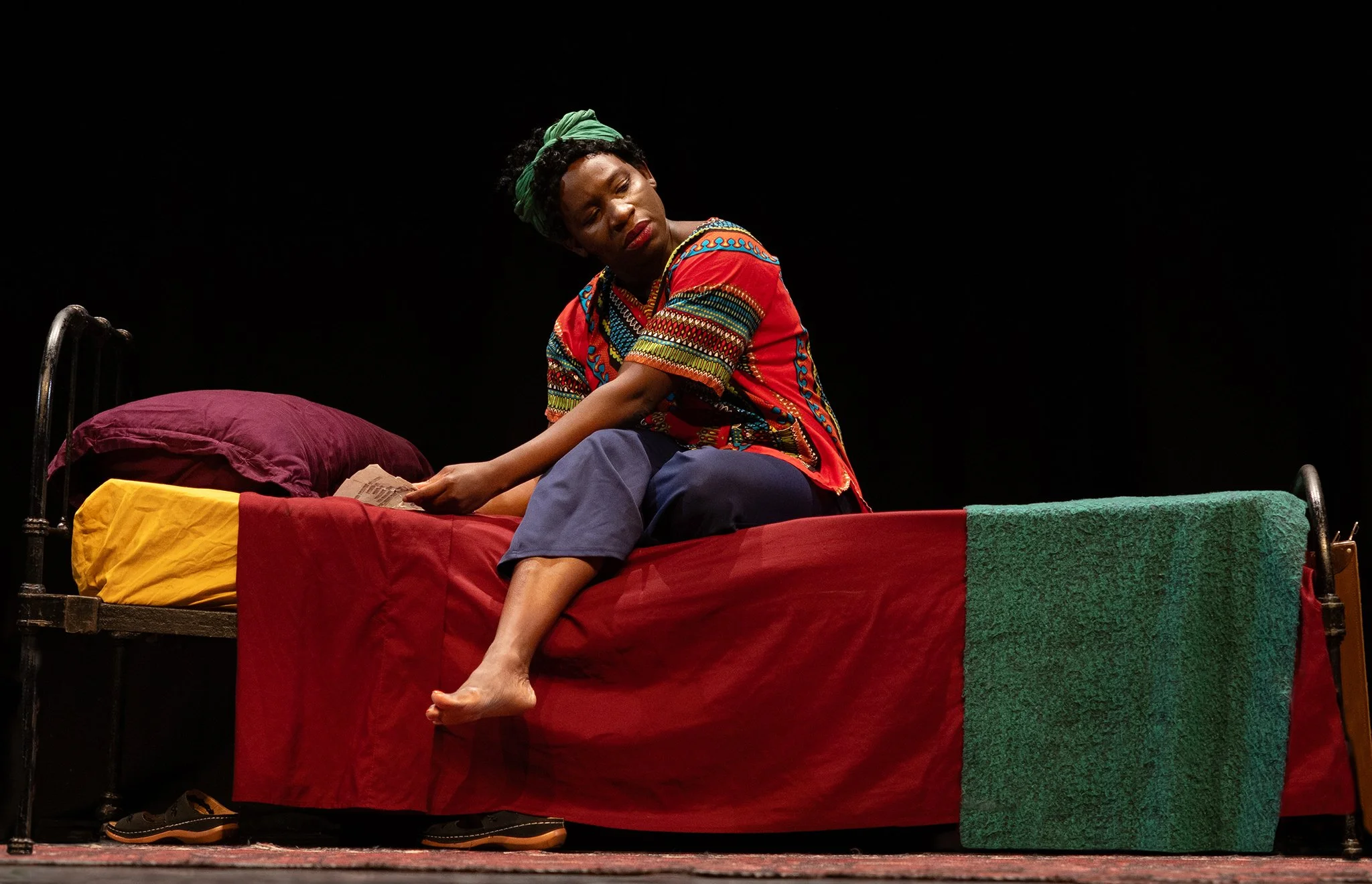
Photography: Rod Penn
Overall, Campbell delivered a performance that was raw, vulnerable and resonated with the audience. Black is the Color of My Voice not only acts as a tribute to Nina Simone’s legacy but as a reminder of the power of music and how it can be used for many causes. Though technical choices could have pushed further, the production is a compelling piece, portraying that agony does not have to be the end of your story but can be the beginning of your transformation.
Black Is The Colour of My Voice |Written and performed by Apphia Campbell
The show has toured the UK and Australia to standing ovations and played sell-out seasons in Shanghai, New York, Edinburgh and the West End of London.
Winner: Best Theatre Award, Adelaide Fringe 2024
The show is currently touring different UK theatres, a special thank you to Seabright Productions for inviting Raw Material reviewers along to see this beautiful show.